Tourist Map of France and Neighbouring Countries
The name France comes from the Latin Francia, which means the country of the Franks. There are many theories related to this name, some of which say that it is derived from the Proto-Germanic word Francon, and others believe that it is from an ancient word known as Germanic.
We will present to you through Europedia 24 europedia24.com the most important cities in France and the tourist places that attract many visitors throughout the year from all over the world.
Map of France and its neighboring countries
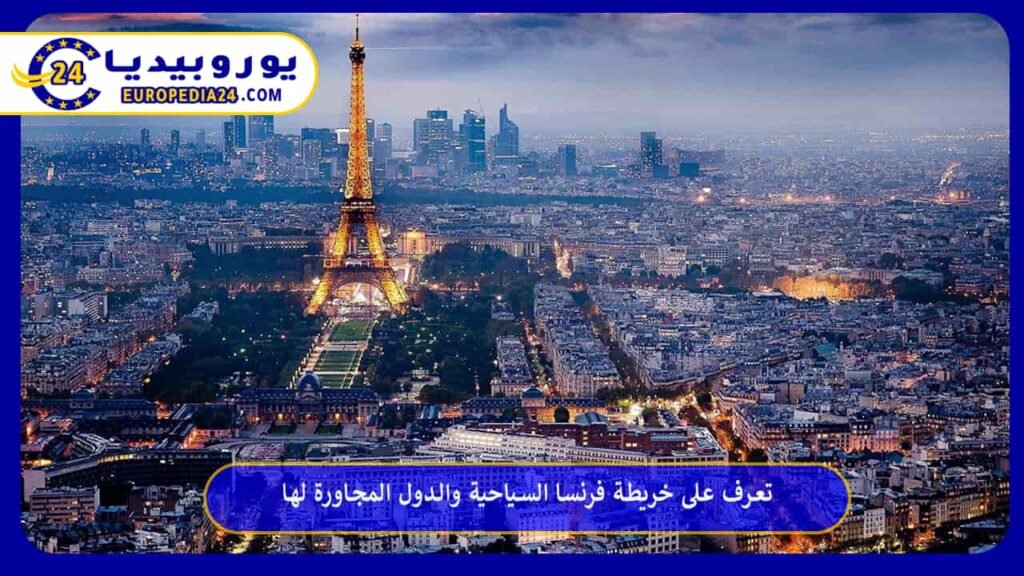
The area of France is estimated at approximately 211,209.38 square miles, and the city of Paris is the capital of France, which is widely known worldwide due to the beauty of the city and the presence of many different distinctive historical monuments.
The map of France shows that the country is located in northwestern Europe and is considered one of the most important countries in the Western world, as it has played a very important role in international affairs.
Through the use of the map, we will find that the Bay of Biscay in the North Atlantic Ocean borders it to the west, while the English Channel borders it to the northwest, and the North Sea to the north.



To the northeast, it is bordered by Belgium, Luxembourg, Germany, Switzerland, and Italy in the east, and the Mediterranean Sea, Monaco, Spain, and Andorra in the south.
France also shares its maritime borders with Britain, and 5 regions also belong to France but outside the country, which are represented on the map in French Guiana in northern South America between Brazil and Suriname.
Guadeloupe is in the Caribbean islands between the Caribbean Sea and the North Atlantic Ocean in southeastern Puerto Rico, while Martinique is in the Caribbean on an island between the Caribbean Sea and the North Atlantic Ocean in northern Trinidad and Tobago.
You can also learn more about Learn about the best ways to invest in France and what are its conditions
In addition to Mayotte in the southern Indian Ocean on an island in the Mozambique Channel halfway between northern Madagascar and northern Mozambique.
For transportation, France relies on one of the most dense networks in the world, with 146 km of roads and 6.2 km of railway lines per 100 square kilometers, as can be seen on the map of France.
France possesses many different mineral resources, including iron ore and bauxite, in addition to zinc, feldspar, fluorspar, and gypsum, in addition to other resources, including uranium, timber, and fish.
But despite the resources that the country is blessed with, it suffers from some natural dangers, namely floods and avalanches, in addition to storms, droughts, and forest fires.
However, despite this, France has been considered the largest country in Western Europe for a long time, as it serves as a gateway between the northern and southern regions.
The vast fertile plains dominate most of the north and west, leading to France becoming the agricultural center of Europe, with the sprawling Central Massif plateau occupying France’s southern interior.
This plateau is considered a group of ancient mountains in addition to inactive volcanoes, and the map of France reveals to us that the north of the country is full of many museums and distinctive cultural and archaeological places that reflect distinctive traditions, customs and heritage.
Read also – Learn about Map of the Netherlands, its cities and borders
Map of France and most important cities
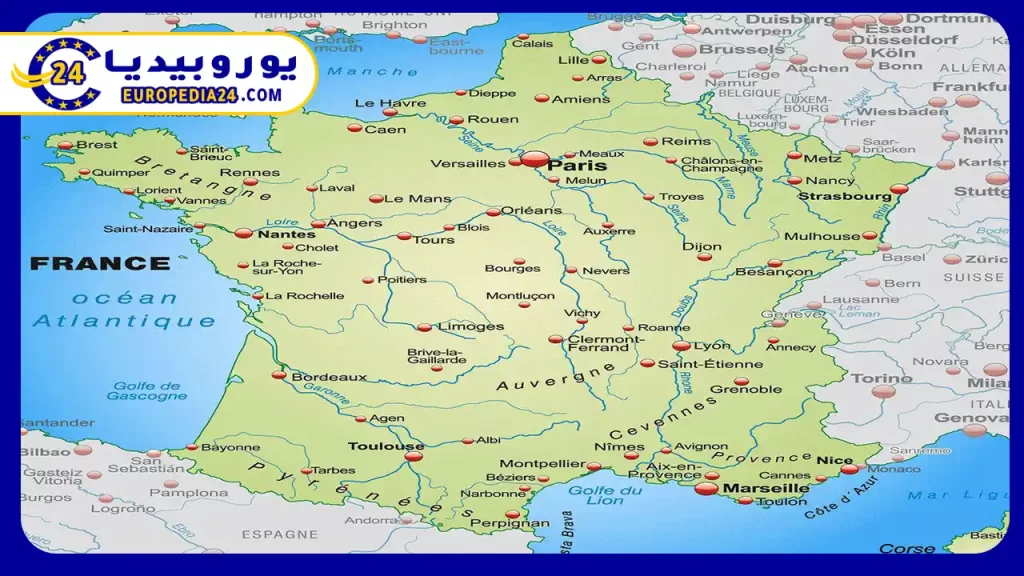
France includes many cities, whether large or small, and the map of France shows that Paris is the largest of these cities in terms of the number of people living within this city compared to other cities.
The cities of the country on the map of France are represented as follows:
- Ex.
- Ejaccio.
- Amiens.
- Anger.
- Avignon.
- Basel.
- Bastia.
- Bayou.
- Bayonne.
- Bezan.
- Besancon.
- Bonifacio.
- Bordeaux.
- Borg.
- Brest.
- Cain.
- Calais.
- He was.
- Chalons en Champagne.
- Chalons.
- En Champagne.
- Charmy.
- Cherbourg.
- Claire Mont Ferrand.
- Dax.
- Dijon.
- Dunkirk.
- Grenoble.
- La Rochelle.
- Le Havre.
- Le Mans.
- night.
- Limoges.
- Leorian.
- Lourdes.
- Leon.
- Marseille.
- Metz.
- Montpellier.
- Mulhouse.
- Perpignan.
- Port bo.
- Reims.
- Ren.
- Rowan.
- Strasbourg.
- Toulon.
- Toulouse.
- Valenciennes.
Read also – Learn about Map of Liechtenstein and the most important information about it
Map of France and most important tourist places
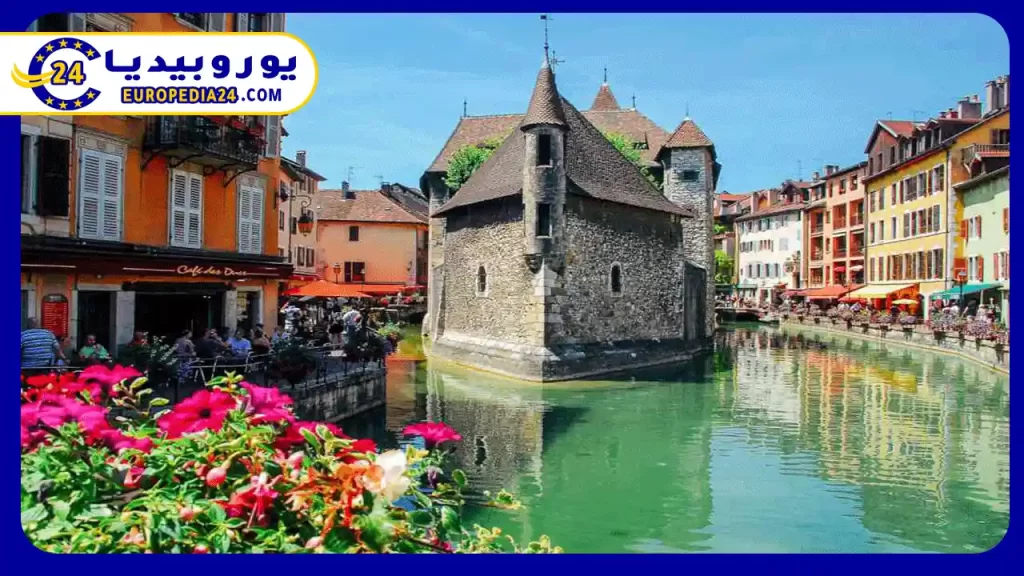
France includes many distinctive tourist places that attract many visitors throughout the year and from all over the world. The most important tourist places on the map of France are as follows:
Chamonix Ski Resort
Chamonix Ski Resort is considered one of the most important and famous ski resorts in the world, not just France, as it is located on the French Alps mountain ranges, specifically at the foot of Mont Blanc.
The resort is considered the ideal place for lovers of snowboarding in the winter, in addition to being a great place for lovers of climbing in the summer, especially on the mountain slopes.
Saint-Tropez Village
The village of Saint-Tropez is one of the most famous tourist villages on the map of France and in the whole world, as it is located on the shore of the French Riviera, and witnesses a large demand for visitors throughout the year.
The village is distinguished by its beautiful and distinctive beaches, in addition to the presence of many various shops and cafes, in addition to the tranquility of the streets, trees, and picturesque landscapes.
You can also learn more about Best used car selling site in France
Saint-Tropez is also famous for its white sandy beaches overlooking the Gulf of Saint-Tropez, with medieval villages, vineyards and lavender fields.
Eiffel Tower
The Eiffel Tower is considered one of the most important tourist attractions in Paris. It is widely known around the world and receives millions of visitors annually. It is one of the most famous and important tourist attractions on the map of France.
The Eiffel Tower was built by Gustave Eiffel in 1889, and from the moment of its construction, it attracted world attention, until today it has become one of the main landmarks that distinguish France, specifically the city of Paris.
Louvre Museum
The Louvre Museum is also one of the most famous tourist attractions in Paris. It is an ancient castle built by King Philippe and is located on the Seine River.
The Louvre Museum contains about more than a million artifacts, including paintings and statues dating back to different civilizations of the world.
Read also – Learn about Map of Turkey and its neighboring countries
Mont Saint Michel Island
Although Mont Saint Michel is a small island on the tourist map of France, specifically located off the coast of Normandy, it is one of the most famous tourist places within the country.
The island is characterized by its winding and winding streets, as well as its distinctive medieval architecture, and is considered a recreation haven in the Manche province.
Bella Dunes
The Bella Dunes are the largest sand dunes in the entire continent of Europe. They are located in the southwest of the map of France, specifically in the Gulf of Arcachon, and they are moving inland, uprooting plants and forests.
The Pyla Dunes are known as the longest sand dunes in the continent of Europe, located between the Atlantic Ocean and a huge pine forest, in addition to the Arcachon Bay, the sandbank and the peninsula.
Read also – Get to know Austria map
Frequently asked questions about France map
Where is France located on the world map?
France is located in the west of the continent of Europe, where it is bordered to the north by the North Sea, and to the northwest by the English Channel, while to the west it is bordered by the Atlantic Ocean, and the Mediterranean Sea to the southeast, in addition to Belgium and Luxembourg to the northeast, and Germany and Switzerland to the east.
What is the largest city in France?
Paris is the largest city in France in terms of population, followed by Lyon, Marseille, and finally Lille.
What is France famous for?
France is famous for its many distinctive tourist attractions, including the Eiffel Tower and the Louvre Museum, in addition to many other historical and archaeological sites.
A concise answer based on search intent
France is considered the largest country in the European Union in terms of area, as shown by the map of France, which confirms that it occupies second place after Germany in terms of overpopulation. In summary: This guide helps you understand the topic in France, clarifying what to check before making a practical decision.
How to use this information with confidence
The value here is not only in displaying information, but in linking it to an actionable step: Do you need to make a reservation, submit an order, compare a cost, review a legal requirement, or confirm with an official body? So we added verification points and direct sources that reduce the possibility of error.
Checks to make before deciding
- Check the official website of the place or city for opening hours, prices and seasonal changes.
- Compare the location with transportation and nearby housing so that the cost of the visit is not higher than expected.
- Use guest reviews as a helpful signal, but check reservations and policies from official channels.
Official sources and trusted references
Frequently asked questions
Do the details differ within France from one city or destination to another?
Yes, many practical details may differ depending on the city, institution, or type of request, so you must refer to the source responsible for your specific case.
Can you rely on this article alone?
The article helps you understand the picture and take a more conscious step, but it does not replace the official source or specialized advice if the decision is legal, financial, or academic.
Editorial note: This content was editorially revised on July 11, 2026 to add a clearer answer to the researcher’s intent, authoritative sources, and practical checkpoints that enhance trust and expertise.
This post is also available in:
 العربية