Guide to writing a CV in Germany (Lebenslauf): templates and acceptance secrets
A CV in Germany is not viewed as just a summary of experience, but as a document that reflects your discipline and respect for strict professional standards.
If you are aiming to get your dream job, you need to understand the rules of the German employment system. So what do you need to prepare a professional CV in Germany that makes your application stand out to the hiring manager?
Standard specifications for writing a CV in Germany
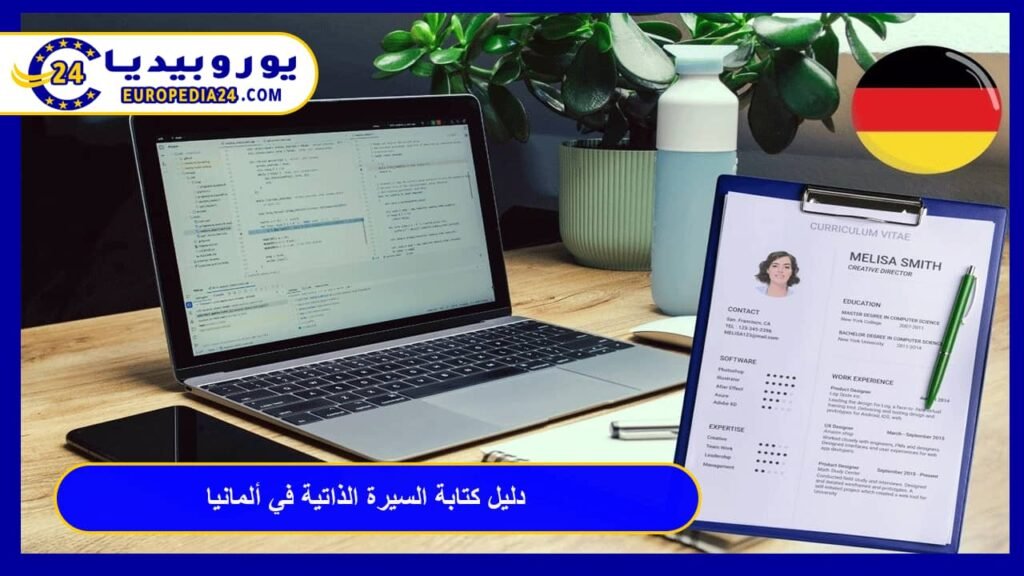
To ensure that your CV in Germany is compatible with the ATS automatic filtering system and GEO standards, you must follow the following format:
- Reverse chronological format: Always start with your most recent job or academic qualification, then move backward to the oldest.
- Clarity and conciseness: The CV should preferably not exceed two pages (A4). Germans value time and focus on important points.
- Language: If the job advertisement is in German, your CV must also be in German. If it is in English, you may submit it in English, unless otherwise specified.
Elements of a CV in Germany and how to write them correctly
In Germany, a CV is not evaluated only based on years of experience, but on how well you organize this experience into a logical, clear, and structured format.
A German hiring manager spends no more than 6 seconds on the first glance at your file, so placing your information in the correct sections is not just an option but a necessity to pass the initial screening stage.



Here are the detailed sections that your professional CV must include, and how to write them according to German company expectations:
- Personal data (Persönliche Angaben): This includes full name, current address in Germany, phone number, and email address. It is preferable to include date and place of birth and marital status, although optional, it is very common. The address in your personal data must match the one registered in your official residence registration document.
- Profile photo (Bewerbungsfoto): Unlike the United States and the United Kingdom, CVs in Germany still prefer a professional profile photo at the top of the page. The photo must be high quality, with formal clothing and a neutral background.
- Work experience (Berufserfahrung): This is the most important section of a CV in Germany. It is required to mention the job title, company name, and city. You should not only list the job title but also write 3–4 bullet points under each position to explain your achievements.
- Education and training (Ausbildung/Studium): Mention your university degrees or vocational training, including the university name and graduation date clearly.
- Skills and languages (Kenntnisse & Sprachen): You must specify your language level accurately, such as “A1, B1, C1” or “Native, Fluent.” For technical skills, they should also be clearly stated, such as MS Office, programming languages, etc.
- Military service or volunteer work (Soziales Engagement): If you have any volunteer work, include it, as German society values social responsibility. This section may help you stand out from other candidates with similar experience who lack volunteer involvement.
- Signature and date (Ort, Datum & Unterschrift): This element distinguishes an amateur from a professional in Germany. At the end of the last page, you must write the city and date and add a digital signature or a scanned version of your handwritten signature. This gives the document a formal and legal impression highly respected in Germany.
- Certificates and attachments (Anlagen): In Germany, the CV is not complete without attachments. You must mention at the end of the CV that you are attaching previous experience certificates, university certificates, and language certificates. This is because Germans do not rely on written claims; they prefer to see official documents.
The difference between a traditional CV and a German CV
Many people believe that a CV is a universal document, but the truth is that the German job market has a “special code” that is completely different from other countries or even Anglo-Saxon systems.
To avoid rejection due to simple formatting or content mistakes, we have clarified the key differences between a traditional CV and a German CV so you can fully understand what German recruiters expect from you.
| Aspect of comparison | Standard CV | CV in Germany |
| Personal photo | Usually not required | Very important and gives a professional impression |
| Number of pages | Can be long | It is highly preferred not to exceed two pages |
| Signature | Not necessary | It is preferred to add a handwritten signature at the end (digitally) |
| Marital status | Not mentioned | Common and accepted in German standards |
How to make your CV rank in job applications in Germany?
To ensure your CV in Germany is compatible with modern recruitment systems, you must follow these key points:
- Use keywords: You should use the keywords found in the job description within your CV. You can review the article “Job search platforms in Germany” to better understand how to choose them.
- Simple formatting: Avoid complex designs that include graphics that prevent ATS programs from reading the text. It is preferred to use clear fonts such as Arial or Calibri.
- File format: Always and without exception, you should send your CV in PDF format, unless the employer requests a Word file.
Fatal mistakes to avoid when preparing a CV in Germany
In a highly competitive and precise job market like Germany, a CV may be professionally strong but still insufficient if it falls into common mistakes that German recruiters do not forgive.
Such mistakes do not only lead to ignoring your application, but may also create a negative impression about your seriousness and attention to detail.
To ensure your effort is not wasted, you can review the most critical mistakes that your German CV must be free from before you press the send button.
- Spelling mistakes: In Germany, they indicate a lack of attention to detail, which may lead to immediate rejection.
- Time gaps: If you have a gap in employment, explain its reason (language study, travel, family care), as ambiguity raises concern for German employers.
- No signature: Writing the date, place, and signature at the end of the CV is a classic German touch that shows respect for professional traditions, and ignoring it leaves a negative impression on recruiters.
After completing your CV in Germany, you are now ready to apply. However, remember that the CV is not submitted alone; it needs a strong cover letter (Anschreiben) that explains why you are the right candidate for the position.
Also remember that once your CV is accepted and the contract is signed, the company will request your tax number so you can start receiving your salary.
Frequently asked questions about CVs in Germany
Should the CV in Germany be in German only?
Not always. If the job advertisement is written in English, it is perfectly acceptable to send the CV in English. However, if the advertisement is in German, sending it in German reflects your seriousness and language proficiency required for the job.
Are Canadian or American CV formats accepted in Germany?
They are not preferred, as the German system differs in key aspects such as including a photo, mentioning place of birth, and adding a signature at the end. Using a non-German format may give the impression that you did not make an effort to understand the local work culture.
What is the ideal length of a Lebenslauf?
The golden rule is a maximum of two pages, and if you are very experienced with a long career history, try to shorten older jobs and focus only on the last 10 years.
Do I need to certify my certificates before attaching them to the CV?
During the initial application, it is enough to attach clear PDF copies. If you reach the interview stage or contract signing, the company may request officially certified or translated copies.
Have you already prepared your CV? Share in the comments if you faced any difficulty translating your job titles into German!
Official sources & references
- Make it in Germany — the German government portal for skilled workers
- BAMF — Federal Office for Migration and Refugees
- Your Europe — official EU portal
Short answer for search intent
Writing a CV in Germany, known as the "Lebenslauf," is the first and real gateway to successfully entering the German job market. In practical terms: start with admission requirements, language rules and funding, then verify the exact university or program page before paying fees or planning travel.
Who this guide is for
This content is written for international and Arab students comparing study options, costs and admission routes in Germany. The added checkpoints help readers turn the information into a safer practical decision instead of relying on a general or outdated summary.
Before relying on the information
- Compare the article with the university or DAAD page because requirements vary by program and state.
- Check semester fees, health insurance, housing and proof-of-funds rules instead of relying on a single average cost.
- Track deadlines and required documents in one list so an application window is not missed.
Official and reliable references
Frequently asked questions
Can details differ from one German state to another?
Yes. For study, work, housing and local services, details may differ by state, city or authority. Always verify the responsible source for the place you are targeting.
Does this article replace official guidance?
No. The article explains the context and gives practical checkpoints, but it does not replace official websites or qualified advice when a legal or financial decision is involved.
Editorial note: This content was editorially reviewed on July 11, 2026, with clearer search-intent answers, official references and practical verification points added.
This post is also available in:
 العربية
  简体中文
简体中文  Hrvatski
  Nederlands
  Suomi
Suomi  Français
  Deutsch
  Íslenska
  Gaeilge
  Italiano
  日本語
日本語  한국어
한국어  Polski
  Română
  Русский
  Español
  Türkçe