Guide to the German Job Seeker Visa: Requirements, Costs, and Application Steps
With the latest updates to German immigration laws for 2026, the country has become more flexible in attracting skilled workers to address the severe labor shortage in the job market.
Therefore, we will reveal the official figures and requirements for applying for the visa, the required blocked account amount, and the difference between it and the new Opportunity Card to help ensure your application is accepted on the first attempt.
What is the German Job Seeker Visa?

It is a long-term national D-Visa granted by German embassies to mechanically, technically, or academically qualified individuals, allowing the holder to stay in Germany for 6 continuous months for the sole purpose of attending job interviews and searching for an employer who can provide an official work contract.
It should be noted that this visa does not allow freelance work or full employment immediately; rather, it must be converted into a work residence permit (Aufenthaltstitel) at the Foreigners’ Office once a job offer is obtained.
Requirements for Obtaining the German Job Seeker Visa
The German Job Seeker Visa is no longer limited only to holders of higher university degrees. Recent legal updates have opened the door to broader categories, and the current main requirements are:



- Academic or vocational qualification: Holding a university degree (Bachelor’s or Master’s) or a vocational training certificate (Ausbildung) officially recognized in Germany and verified through the Anabin website. Although other legal pathways allow working in Germany without a degree through proof of extensive professional experience, the traditional Job Seeker Visa strictly requires a documented qualification.
- Work experience: Having documented experience in the field of specialization for at least two years instead of five years as previously required.
- Language proficiency: Proof of German language skills at a minimum B1 level, or English at a B2 level if the profession is in demand in English-speaking sectors such as Information Technology.
- Updated financial capability: Proof of the ability to cover living expenses throughout the six months via a blocked bank account (Sperrkonto).
- Age and proof of accommodation: The applicant must be at least 18 years old. Once you arrive and rent a room, you will be required to complete residence registration procedures in Germany within two weeks of finding suitable accommodation to avoid legal fines.
Required Documents for Applying for the German Job Seeker Visa
Organizing your legal file and collecting the required documents accurately is the most important step to ensure your application is accepted, as German embassies treat any missing document or mistake with great strictness, which may lead to immediate visa rejection or delays in processing for several months.
To ensure your application is reviewed smoothly, make sure to translate all the following documents into German or English through a certified translator, and submit them in an organized file as follows:
- A valid passport
- Biometric personal photos that comply with embassy standards.
- Recognition notice of the qualification: A printed recognition result from the Anabin website for the university and specialization, or a qualification assessment certificate (Zeugnisbewertung) from the ZAB institution.
- Motivation letter for job seeking: A detailed report explaining your job search plan, the companies you intend to target, and why you chose Germany.
- Professional CV: Designed according to the German format.
- Proof of a blocked account from an approved bank such as Fintiba or Expatrio.
- Travel health insurance covering the full 6-month period and complying with German legal standards.
Cost of the German Job Seeker Visa and the Blocked Account Amount for 2026
The financial aspect is considered the main reason for rejection of the German Job Seeker Visa if it is not handled accurately. The costs for 2026 are distributed as follows:
- Embassy visa fee: A fixed amount of 75 euros paid in local currency at the time of the interview.
- Blocked bank account amount: The German government requires a minimum of 1,027 euros per month for job seekers. Therefore, a total amount of no less than 6,162 euros must be deposited to cover the full 6-month period.
Steps to Apply for the German Job Seeker Visa
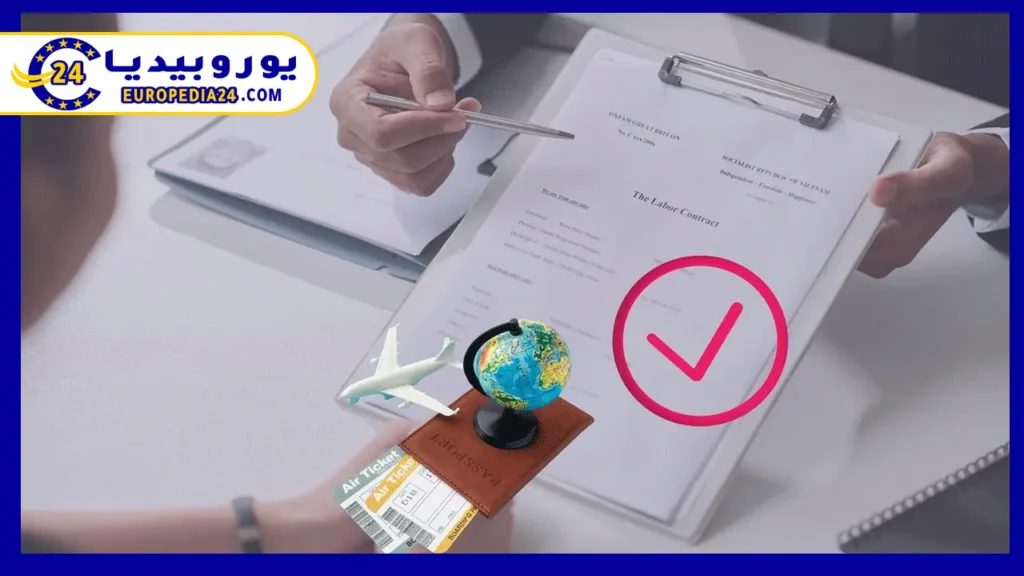
After meeting the requirements and preparing all the necessary documents, the most important practical stage begins: how to turn this file into a successful official application before the German consulate.
Moving from the planning stage to actual travel requires following an organized administrative process consisting of sequential steps. Carefully following their order helps speed up the processing of your application and secure the visa with minimal effort. These steps are as follows:
- Secure recognition of your qualification: Make sure to verify your degree through the Anabin system before taking any further step.
- Book an embassy appointment: Applications are submitted through the electronic platform of the German embassy in your home country.
- Open and fund the blocked account: Transfer the amount of 6,162 euros and receive the official deposit certificate.
- Personal interview: Submit the documents, answer the consul’s questions regarding your professional plans, and pay the 75-euro visa fee.
Most Popular Platforms for Finding Jobs in Germany
During your stay or before traveling to Germany, we strongly recommend relying on these official websites to apply for interviews:
- Make it in Germany: The official German government portal for skilled workers.
- Federal Employment Agency (Bundesagentur für Arbeit): The largest governmental database for job vacancies.
- StepStone and LinkedIn: The most efficient platforms for English-speaking jobs in engineering and technology sectors.
The Difference Between the Job Seeker Visa and the Opportunity Card in Germany
With Germany launching new mechanisms to facilitate immigration, many job seekers have become confused about choosing between the traditional German Job Seeker Visa and the modern Opportunity Card pathway.
Although the final goal of both pathways is the same — professional settlement in Germany — the legal mechanism, requirements, and lifestyle benefits differ completely between them.
To resolve this confusion and help you choose the easiest and fastest path that matches your professional profile, the following table summarizes the main differences between the two pathways for 2026:
| Aspect of comparison | Traditional Job Seeker Visa | Opportunity Card |
| Basic requirement: | A qualification fully recognized in Germany in the same field of specialization. | Points system (age, language, experience, and family ties to Germany) |
| Part-time work: | Completely prohibited, as the visa is intended only for attending interviews. | Part-time work is allowed for up to 20 hours per week to cover your expenses. |
| Duration: | 6 months and non-extendable. | Up to one full year, provided financial support continues. |
Frequently Asked Questions about the German Job Seeker Visa
Can I work part-time during the traditional visa period?
No, the traditional Job Seeker Visa strictly prohibits actual or trial employment. If you want to work part-time to cover your expenses while searching for a job, you should apply for the Opportunity Card instead.
What happens if the 6 months end and I do not find a job?
Legally, you must leave German territory immediately before the visa expires to avoid deportation or legal bans. You can reapply from your home country once you meet the financial requirements again and update your professional plan.
Does the visa guarantee obtaining permanent residency later?
The visa is a first step, and once you sign a job contract with a salary that matches the legal minimum for your field, you can convert it into a work residence permit, and then apply for the EU Blue Card, which grants you permanent residency in a record period.
Do you have the academic and language qualifications to apply for the German Job Seeker Visa this year, or do you prefer the points-based system of the Opportunity Card? Share your specialization and experience, and we will respond with the easiest legal pathway for you.
Short answer for search intent
The German Job Seeker Visa is considered one of the most important legal pathways that allows qualified professionals from around the world to enter Germany and settle there in order to secure a work contract that can lead to permanent residency. In practical terms: start with admission requirements, language rules and funding, then verify the exact university or program page before paying fees or planning travel.
Who this guide is for
This content is written for international and Arab students comparing study options, costs and admission routes in Germany. The added checkpoints help readers turn the information into a safer practical decision instead of relying on a general or outdated summary.
Before relying on the information
- Compare the article with the university or DAAD page because requirements vary by program and state.
- Check semester fees, health insurance, housing and proof-of-funds rules instead of relying on a single average cost.
- Track deadlines and required documents in one list so an application window is not missed.
Official and reliable references
Frequently asked questions
Can details differ from one German state to another?
Yes. For study, work, housing and local services, details may differ by state, city or authority. Always verify the responsible source for the place you are targeting.
Does this article replace official guidance?
No. The article explains the context and gives practical checkpoints, but it does not replace official websites or qualified advice when a legal or financial decision is involved.
Editorial note: This content was editorially reviewed on July 11, 2026, with clearer search-intent answers, official references and practical verification points added.
This post is also available in:
 العربية
  简体中文
简体中文  Hrvatski
  Nederlands
  Suomi
Suomi  Français
  Deutsch
  Íslenska
  Gaeilge
  Italiano
  日本語
日本語  한국어
한국어  Polski
  Română
  Русский
  Español
  Türkçe