Student Loans in Germany: Eligibility and Requirements
The role of a student loan is not only to cover living expenses, but also to finance studies and obtain a good level of education, although education in Germany is characterized by its low cost and in some cases is obtained free of charge.
Of course, there are certain categories that are eligible for a student loan, in addition to having a lot of requirements.
Advantages of Obtaining a Student Loan in Germany “The Bavug”
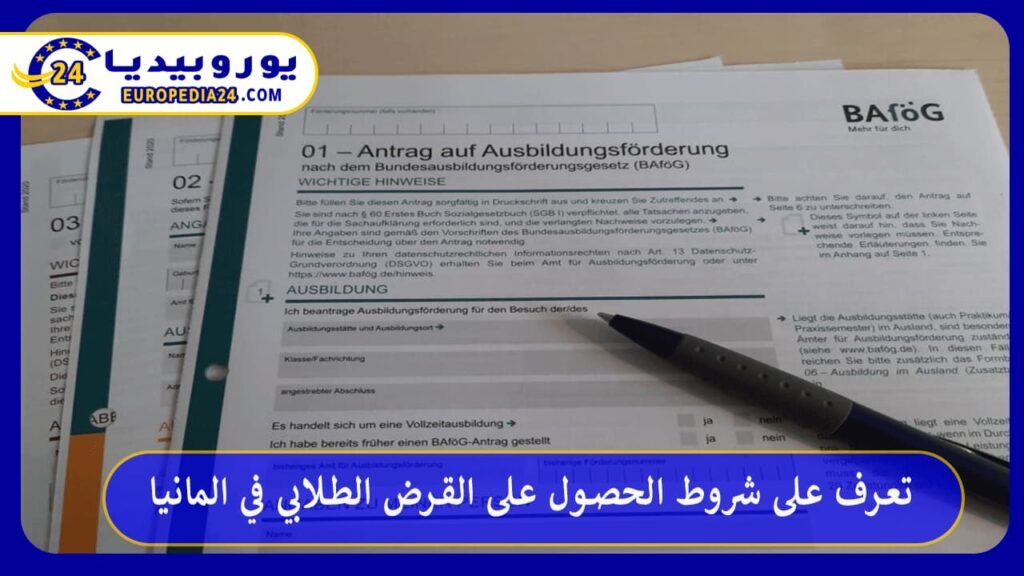
A student loan in Germany is a method provided by the state to provide educational funding to students, whether they want to obtain a bachelor’s or master’s degree.
Student loans in Germany are also known as BAFOG, which is an abbreviation of the word Bundesausbildungsforderungsgesetz.
Germany is working to provide student loans to all students in the country, on a monthly basis, based on the Federal Education Support Act.



The duration of the loan is determined by the German government based on the nature of the student’s situation, which is determined during the approval of the loan to the student.
The BAfög provides many advantages for students in Germany, which are represented in the following:
- You can get a student loan in Germany easily without complicated procedures.
- The loan helps to cover the expenses of life in Germany.
- It helps to provide funding for studying in Germany.
- The loan amount is disbursed on a monthly basis in order to help students.
- The loan amount is determined in proportion to the nature of each student.
It should be noted that the student loan cannot be determined by a specific amount, because it depends on many conditions and factors represented in the following:
- The student’s possibilities and income, his/her parents or partner.
- In case of any additional income, the loan amount will be reduced.
- In case of high additional income, the loan will be denied.
- People under the age of 25 will get a loan of around €752 per month.
- People between the ages of 25 and 29 will receive €861 per month.
- People who turn 30 will receive €941 per month.
Also Read – What are the Terms and Benefits Study in Australia?
Categories Allowed to Obtain a Student Loan in Germany
Germany allows all students who want to study in the country to easily obtain a student loan in Germany, but only if the student cannot afford to live during the period of stay.
Accordingly, Germany allows the possibility of obtaining a loan after meeting all the required conditions, but in general, the categories allowed to obtain the loan are as follows:
- Syrians who came to Germany before February 1, 2013.
- German citizens.
- Citizens of EU countries.
- Non-deportation residence permit holders, but only if they have been in Germany for at least 15 months.
- German residence permit holders.
- People who do not possess any nationality or identity.
- Refugees in the event of obtaining refugee residency or subsidiary protection.
- Students with physical disabilities.
- Pregnant female students.
- Students with children.
Also Read – What are the Terms and Benefits Study in Spain?
Conditions for obtaining a German Bafog loan

After learning about the categories that are allowed to obtain a student loan in Germany, you must adhere to the required conditions, which contribute to increasing the chances of obtaining approval as soon as possible.
The conditions required to obtain a Bafog loan are as follows:
- The applicant must be no more than 30 years old in case of undergraduate study.
- The applicant must be no more than 34 years old in case of master’s study.
- Clarification of the financial situation of the applicant or his/her parents.
- Not to change the specialization of study after applying for a loan.
Although it is stipulated that the study should not be changed after applying for the loan, there are some cases in which the loan can be obtained with a change in the subject of the study, which are represented in the following:
- If studying abroad for more than 4 semesters.
- Study 5 semesters and change the subject of the study, and here the student is not entitled to receive the loan unless there is a convincing reason to change the subject.
Also Read – Best Universities, Institutes and Costs Study in Switzerland
Documents Required for the Bafog Student Loan
There are some required papers and documents that you must prepare, in order to attach them to the application and send them to the competent authorities, where you can get the application forms through This link.
These documents must carry the correct information, in order to enhance the chances of obtaining approval easily, and the required documents are as follows:
- All personal data must be filled in correctly.
- A copy of the residence permit issued by the Foreigners’ Office.
- A copy of the first paper from the Employment Office or as it is known as the Job Center.
- Document from the Social Affairs Office “Social Umt”.
- A copy of the housing lease contract.
- A bank statement in Germany showing the applicant’s ability to afford daily expenses.
- Formula No. 3 related to parents.
- A formula about the partner in case of marriage.
- Submit Annex 1 to Formula 1, which is the documents related to the previous study, with an explanation of the type of study and the specialization.
- Form No. 2 and must be filled out from the reception desk at the university where the study is to be held.
Also Read – Learn About Costs Study in Liechtenstein For the Arabs Liechtenstein
Steps to apply for a student loan in Germany

The process of applying for a student loan in Germany is simple and easy, with no complications at all.
After meeting the required conditions and preparing all the paperwork, you can apply for a Bafog loan with ease, by following the following steps:
- Fill out the loan application form.
- The required form and paperwork will be handed over to the department responsible for educational support in the city where you will be studying.
- You can use the internet to apply on the page of the Federal State Administrations of Germany.
Also Read – Top Ways to Get a Visa Study in the Netherlands
Student loan time period in Germany
We also explained that Germany determines the time period for obtaining a student loan in Germany, during the application process, as it is determined based on the duration and nature of the study.
There are some exceptional cases in which the extension of financing and the loan term in general are allowed, as these cases are as follows:
- In case the student wishes to complete the study in order to obtain a master’s or doctorate.
- Changing the kidneys for compelling reasons.
- Childcare or the discovery of a pregnancy.
- The completion of the study was delayed on time for compelling personal reasons.
- In case you do not pass the final exam once.
Also Read – What are the Terms and Benefits Study Law in Belgium?
Student loan repayment methods in Germany
Student loans in Germany are repaid in convenient monthly installments, commensurate with the student’s income, in order to overcome the high cost of living.
It should be noted that the Bafog consists of two parts, where the first part is represented in half of the amount as a grant from the German government and is not repaid.
The second part is paid after a period of up to 5 years, and sometimes up to 10 years, with a monthly installment of about 130 euros.
In case the student is able to pay the amount due in one lump sum without installments, here he can get a discount of up to about 10%.
Monthly allowance of the Bafog student loan

The German government has decided to increase the monthly allowance for students, which will reach 452 euros per month, in addition to the housing allowance for students who do not live with their families by 11%.
Accordingly, the financial support amounts to €934, an increase of up to 8%, in addition to a heating allowance of €230, which is only obtained once.
Also Read – Know How Long Study Engineering in France And the most famous specialized universities
Frequently Asked Questions about Student Loans in Germany
What is a student paugh in Germany?
The Student Bafog in Germany is a student loan granted by the state to students who cannot afford to study and live within the country.
How is the amount of a student loan in Germany determined?
Student loans in Germany vary from person to person, depending on the nature of the person, the size of the expenses and income, as well as the nature and place of study.
Short answer according to research intention
The student loan in Germany is one of the most important assistance provided by the state to students, in order to overcome the high living expenses in the country, whether housing or daily living expenses. In short: start with the admission requirement, language, and funding, then check the details of the university or program before arranging travel or paying any fees.
Who benefits from this guide?
This content is aimed at Arab students and those planning to study or train in Germany. Therefore, checkpoints have been added that help you turn information into a practical decision while reducing the risk of relying on general or outdated information.
Before you rely on the information
- Compare the admission requirements in the essay with the university page or DAAD, as the requirements vary by program and state.
- See the actual cost: Semester fees, health insurance, housing, and proof of financing calculation, if applicable.
- Keep the application dates and required documents in one list so you don’t miss an important appointment.
Official Sources and Reliable References
Frequently Asked Questions
Do the details vary from German state to state?
Yes, in subjects such as study, work, housing, and local services, details may vary by state or city, so you should consult the responsible party in the target location.
Does this article replace the official source?
No. The article explains the image and gathers important checkpoints, but does not replace official websites or specialist advice when there is a direct legal or financial impact.
Editorial Note: This content was edited on July 11, 2026 to add a clearer answer to the researcher’s intent, official sources, and practical checkpoints that enhance trust and expertise.
This post is also available in:
 العربية
  简体中文
简体中文  Hrvatski
  Nederlands
  Suomi
Suomi  Français
  Deutsch
  Íslenska
  Gaeilge
  Italiano
  日本語
日本語  한국어
한국어  Polski
  Română
  Русский
  Español
  Türkçe