How to Calculate Income Tax in Germany
Income tax in Germany One of the most important types of taxes that exist in many countries around the world, whose origins date back to ancient times and were adopted by many countries to deduct a percentage of the income of individuals working in the country, and to add that tax to the national income to invest it in various fields and benefit citizens again.
So let’s through this article on an encyclopedia Europedia 24 europedia24.com, learn about this type of tax and its basic information, as well as learn about the advantages of the tax system available in Germany and the benefits it brings to individuals.
We will also cover all the types of taxes such as VAT in Germany and other types of taxes, how to calculate your salary after tax and answer all related queries.
Types of Taxes in Germany

Income tax in Germany (Einkommensteuer) is the most important type of tax collected from certain groups within the country, and most of the income collected from taxes is related to income tax.
Income tax in Germany is so named, because it is due to any employee who receives their income from working in the country.
Germany is one of the developed countries in the world where the value of taxes is high, whether you are a citizen of the country or an immigrant to work in it, and there are a number of taxes that you should know about before arriving in Germany so that you do not be surprised.
Some of the most prominent types of taxes in Germany are:
- Income tax in Germany.
- VAT.
- Corporate Taxes.
- Property tax.
- Investment tax.
- Taxes on cars.
- Transfer taxes.
These are all types of taxes in Germany, but today we are going to talk and learn more about income tax in Germany, its details and methods of calculating it.
So if you are an immigrant to work in Germany, here is a set of information that you should know and memorize by heart.
Also Read – The Most Important and Best Arab Companies in Germany
Income taxes in Germany
Despite the significant increase in wages for workers in Germany, there are taxes that are deducted directly from the monthly income of workers here.
This type of tax is known as income tax (German: Einkommenssteuer) and represents the deductible percentage of the salaries of workers in all sectors in Germany, but in reality it has a preview criteria.
You can find out the deductible percentages of workers’ salaries according to income tax in Germany through the following:
| The value of the annual income per capita | Percentage of taxes imposed on it |
| 9744 EUR and below | 0% |
| Between 9744 EUR: 57918 EUR | 14%: 42% (varies according to value) |
| Between €57,919: €274612 | 42% |
| More than 274612 euros | 45% |
Income tax brackets in Germany
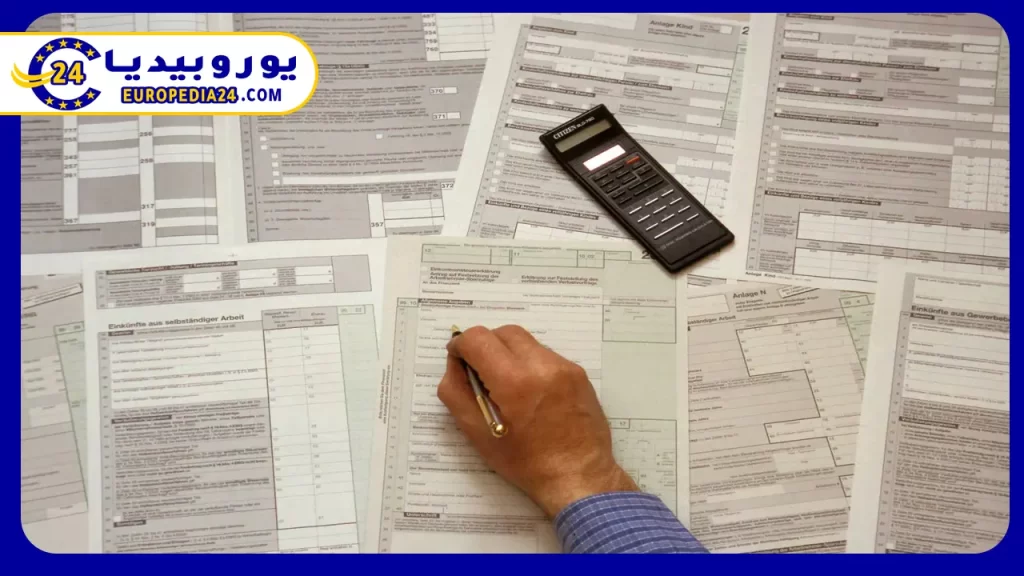
There are many categories that fall under income tax, among which are different segments and each has its own cost, which comes as follows:
The first tranche of income tax in Germany
The first tranche of income tax in Germany includes single or divorced employees living separately, as well as widows, and individuals who are eligible for the third tier are excluded.
The second tranche of income tax in Germany
It includes both parents who live separately with their children without being married.
This category is entitled to child allowance (“Kinderfreibetrag”) or child allowance, which is called “Kindergeld”.
An individual is only included in this segment if he or she was in the previous year, and if he has not been in that segment before, the application to join that segment is submitted after filling out the following form:
The third tranche of income tax in Germany
Widows fall into this category of income tax in Germany, and it is applied to them in the same year as the spouse or the year following that.
One spouse can join this tax if the second party receives much less money and immediately the second partner with a lower income is classified as the fifth tranche.
The fourth tranche of income tax in Germany
This bracket is standard for both couples or partners of the same type, and the pairs are automatically placed in that bracket, in which case it is ideal for both parties if they earn the same amount of money.
The fifth tranche of income tax in Germany
This is the third tranche counterpart, and partners of the same type (homosexuals) can do so if they choose to join the third tranche if they choose to join the third tranche of the same sex.
Sixth tranche of income tax in Germany
This segment includes individuals who have any additional work in addition to their own work.
NoteIf the individual’s marital or employment status is changed, he will be transferred from that segment to the segment that is proportional to him, and the married person has the right to choose between more than one segment that is proportional to him.
Individuals who work in the private sector pay income tax in Germany (Einkommensteuer) instead of “Lohnsteuer”, and are not divided into wage tax categories, but are included in the tax brackets if the husband or wife works as an employee.
Also Read – How to Car Insurance in Germany What are its types?
How to calculate income tax in Germany
From the information mentioned in the previous paragraph, the vision is a little clear, but now you are a worker or employee in Germany and your annual income ranges between 9,744 euros and 57,918 euros, do you pay taxes on 14% or 42%?
This question is a common question, and simply if your income is small and close to the lowest value per year, you will definitely be charged for the lower value of taxes and vice versa.
Example to illustrate:
Assuming you are employed in Germany and earn a salary of €20,000 per year, based on the tax schedule mentioned above, you will pay a tax value of €2,266, which is equivalent to 11 percent of your income.
In addition, you will receive from the state an increase in your salary next year estimated at 100 euros per month, equivalent to 1200 euros per year, so that your annual income will be 21,200 euros, thus increasing the value of salary taxes in Germany deducted from your salary to 12.18%.
Another way to calculate income tax in Germany
You can also calculate income tax in Germany And extract your salary from it easily by registering your data on the following website from here.
You can also download the Germany Income Tax Calculator app on Android phones by clicking on this Link.
You can also get the app for iOS phones and tablets by tapping here, then install the app and follow these steps:
- First, you have to put the Bruttolohn Comprehensive Basic Salary in Euros.
- Then you have to choose the tax bracket you fall into.
- You should choose the province you live in in Germany because there are some differences between each province and the other.
- Determine whether or not you are required to pay taxes to the church depending on the religion.
- Add whether you have children or not and add the number of them.
- Select the public health insurance (the option that is already available do not change it).
- You will be shown the percentage of income tax you owe in Germany.
- Add your current age.
- Select a monthly or yearly salary calculation system, specify that it is monthly and select the current year.
- It will eventually show you the net salary, the amount of deductions and the things that have been deducted.
Deduction tax in Germany
Withholding tax is another type of income tax in Germany, this type of tax is deducted directly from your salary by your employer or the company you work for.
The withholding tax in Germany applies to the vast majority of workers, whose annual salary exceeds €9,744.
But it should be noted, if you only have one source of income or only work in one place and have no other, you are not required to file a tax return.
If you have more than one source of income, you will need to file a tax return detailing each income in order to avoid fines, tax fines in Germany are very difficult.
In addition, withholding tax is agreed upon in the contract between you and the entity you work for or wish to work for.
Therefore, you need to be fully aware of the value of the tax deductions added in the contract to decide whether or not this employment contract is right for you and your needs, as there is a big difference between your total salary and your net salary after tax deductions.
The withholding tax is an “umbrella” under which a number of taxes are covered, the most prominent of which are the following:
- Salary tax.
- Insurance taxes.
- Taxes imposed on in-kind features.
- Solidarity taxes.
- Church tax (if you are Jewish or Christian).
In addition, social security payments, the most prominent of which are the following:
- Health insurance tax.
- Retirement Insurance Tax.
- Long-term health care insurance.
- Unemployment Insurance Tax.
These taxes are definitely not borne by you alone, as your employer or company you work for is responsible for paying 50% of them, and the rest is deducted from your monthly salary at a rate ranging from 20% to 22% to the concerned social security authorities.
Also Read – Things You Don’t Know About Buying a House in Germany It harms you if you don’t know it
Solidarity Supplementary Taxes
This type of tax (solidarity surcharge) is closely related to income tax in Germany.
The additional solidarity taxes represent 5.5% of income tax, capital gains tax, as well as corporate taxes.
This type of tax was announced in 1991 and was intended to start the reunification of Germany again, and the value of these taxes was to be provided to pay off East Germany’s debts and citizens’ pensions there.
However, starting in 2021, specifically in January, the additional solidarity tax fees on income tax were significantly increased, prompting the German government to eliminate this additional cost from 90% of the country’s taxpayers.
It was announced that unmarried people whose annual income in Germany did not exceed €61,700 per year would not pay this amount of tax.
What is a church tax?
Church tax is basically part of income tax in Germany.
However, the church tax is not imposed on all religions there, it is only imposed on both Jews and Christians.
The church tax is deducted by the tax office on behalf of the religious institutions of these religions in the country, and if you differ in religion from the previous religions, you are not required to pay this tax.
Also Read – Learn All About the World Health Insurance in Germany
Tax deductions in Germany

Germany’s tax system gives some citizens or immigrants working in the country the opportunity to receive a range of tax deductions.
This is to ease the tax burden of the German state on individuals, as is the case with the child benefit tax (German: kinderzuschlag).
There are a number of payments through which tax deductions are provided, the most prominent of which are the following:
- The value of the expenses of the various functions.
- Transportation expenses between different places in Germany.
- Expenses and expenses of divorcees or separated couples.
- Charity by making contributions to German charities.
- The cost of care for children.
- Tuition and Educational Expenses.
- Social Security Contributions Expenses.
- Church taxes levied on Christians and Jews.
- Mortgage payments in Germany.
How to calculate net salary in Germany
After talking about all the previous details about payroll taxes in Germany, I think you’re now distracted and would like to know how much of your salary you have left over if the value of the above taxes is deducted from your salary, right?
Now, we’ve made sure to help you provide you with a way to find out about your net salary at the end of the month.
Simply enter the Germany tax calculator from here Start by following the steps and filling out the form to find out the details of your net salary in Germany after deducting the taxes imposed on you.
Also Read –
VAT in Germany
Speaking of income tax in Germany, VAT is an additional tax for citizens in Germany.
This type of tax is imposed on the owners of productive enterprises, where a return of this tax is submitted to the tax office on an ongoing basis.
Different entrepreneurs add value to the invoice with which the customer buys their products anywhere in Germany, and the value of the VAT is estimated at 19% of the value of the product provided to the customer.
How to file an income tax return in Germany

The German system holds individuals accountable on their payroll.
If an individual is an employee, his payroll is transferred directly to taxes, and the tax return is submitted periodically by all employees in the country, but the following conditions must be met:
- If the person’s salary falls under the category of additional income, in addition to part-time jobs, the monthly return is more than €410 per month.
- He must file a tax return for individuals receiving unemployment benefit from the country, which is worth more than €410 per month.
- The person files the tax return in the event of marriage or divorce in the same year, or if he is married under both the third or fourth tranche.
Corporate Taxes in Germany
The taxes paid by companies in Germany are varied, as it is clear from the corporate tax announcements according to 2021, that companies are divided into two types, (companies) and (partnerships) and for each type of certain taxes that they must pay in full, more details come below:
Corporate Taxes In Germany
In this first type of company (for a single individual), a set of taxes are paid, the most prominent of which are the following:
- Corporate and Solidarity Taxes.
- Income taxes of individuals working in the company.
- VAT on the product or service provided by the company.
- Commercial taxes levied.
Partnership Taxes in Germany
This is the second type of company, which is a partnership between more than one individual or more than one party, and it has other types of taxes imposed on it, some of which share with corporate taxes as well, which are:
- Income tax in Germany for individuals working for the company.
- Commercial taxes levied.
- VAT on products and services.
- Social solidarity taxes on employees of the company.
Also Read – Get to Know Best Shopping Sites in Germany
Questions asked by others about income tax in Germany
How do I calculate my salary in Germany?
You can easily find out your net salary by entering our Germany income tax calculator.
What do Proto and Neto mean in Germany?
Proto, which is a Latin word for gross (i.e., salary without taxes), or nito, it means net salary after taxes.
How much does it cost to live in Germany?
The cost of living in Germany is not expensive, and even after deducting income tax in Germany, you can get a privileged living, as all you need a month in Germany is only 850 euros, including house rent and monthly expenses.
How many hours do you work in Germany?
According to the latest updates, the number of working hours in Germany ranges from 38 to 1/2 to 40 hours per week, which is the number of full-time working hours in Germany, while for part-time, the working hours range between 20 to 30 hours per week.
Short answer according to research intention
Income tax in Germany is one of the most important types of taxes that exist in many countries around the world, and its origins date back to ancient times and were adopted by many countries to deduct a percentage of the income of individuals working in the country, and add this tax to the national income to invest it in various fields and benefit citizens again. In short: start with the admission requirement, language, and funding, then check the details of the university or program before arranging travel or paying any fees.
Who benefits from this guide?
This content is aimed at Arab students and those planning to study or train in Germany. Therefore, checkpoints have been added that help you turn information into a practical decision while reducing the risk of relying on general or outdated information.
Before you rely on the information
- Compare the admission requirements in the essay with the university page or DAAD, as the requirements vary by program and state.
- See the actual cost: Semester fees, health insurance, housing, and proof of financing calculation, if applicable.
- Keep the application dates and required documents in one list so you don’t miss an important appointment.
Official Sources and Reliable References
Frequently Asked Questions
Do the details vary from German state to state?
Yes, in subjects such as study, work, housing, and local services, details may vary by state or city, so you should consult the responsible party in the target location.
Does this article replace the official source?
No. The article explains the image and gathers important checkpoints, but does not replace official websites or specialist advice when there is a direct legal or financial impact.
Editorial Note: This content was edited on July 11, 2026 to add a clearer answer to the researcher’s intent, official sources, and practical checkpoints that enhance trust and expertise.
This post is also available in:
 العربية
  简体中文
简体中文  Hrvatski
  Nederlands
  Suomi
Suomi  Français
  Deutsch
  Íslenska
  Gaeilge
  Italiano
  日本語
日本語  한국어
한국어  Polski
  Română
  Русский
  Español
  Türkçe