
Geneva’s Jet d’Eau: Famous Swiss Landmark
The fountain witnesses a wide demand from tourists from all over the world, to witness the splendor and beauty of the fountain, in addition to the splendor of its design and construction.
Although Switzerland has many other famous landmarks, including banks, cowbells, and clocks, the Geneva Fountain is immediately associated with Switzerland.
We will present to you through Europedia 24 europedia24.com what are the features of the wonderful Geneva Fountain and how to reach it, as well as the most important activities that can be done.
What is the Geneva Fountain in Switzerland?
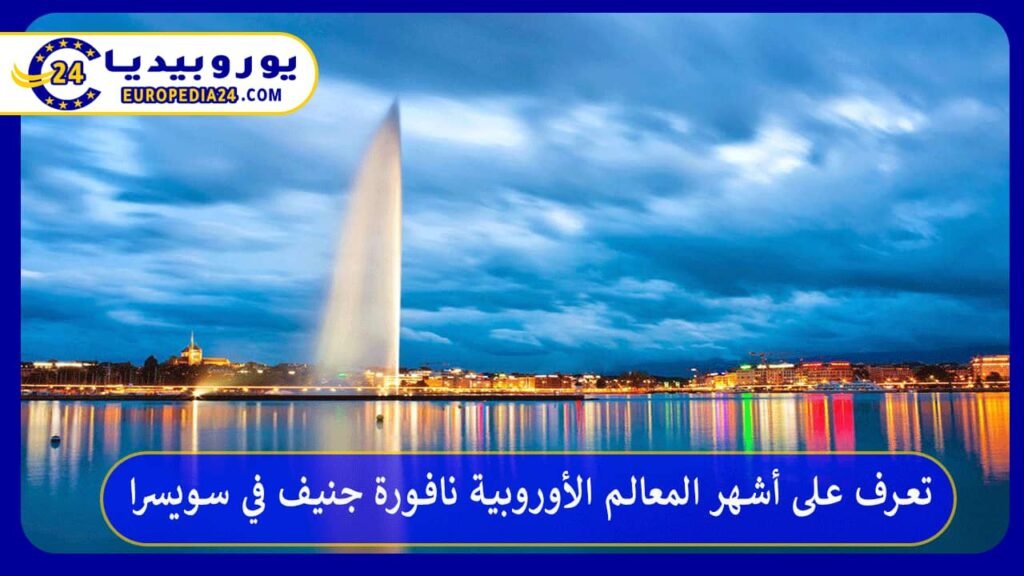
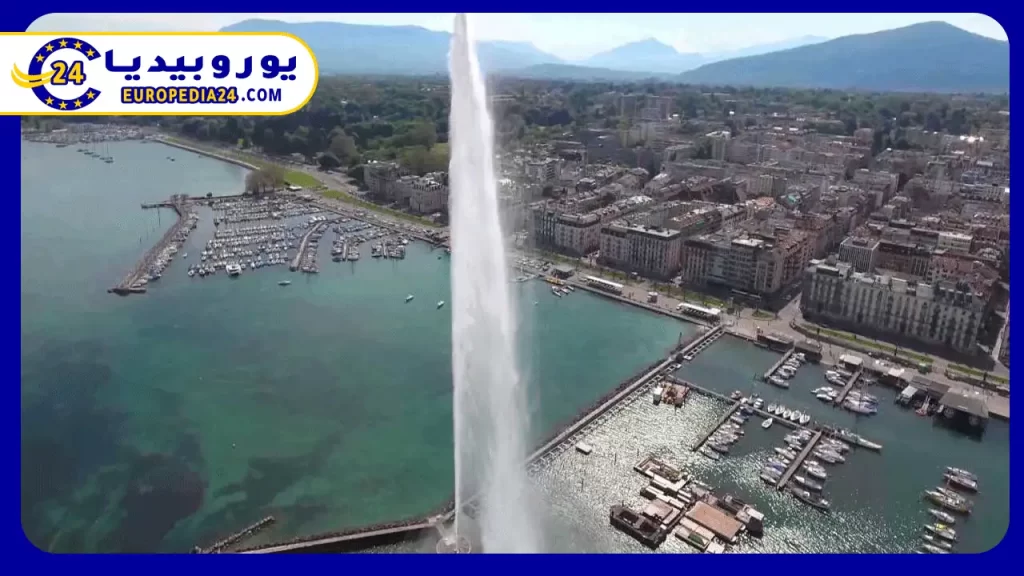
Geneva’s Jet d’Eau is one of the most important and famous tourist attractions. It was built in 1886 and is as high as the Statue of Liberty. It is considered one of the tallest fountains in the world.
The fountain pumps about 7 tons of water at a speed of up to 200 kilometers per hour, relying on electric pumps that pump water to a height of about 140 meters.


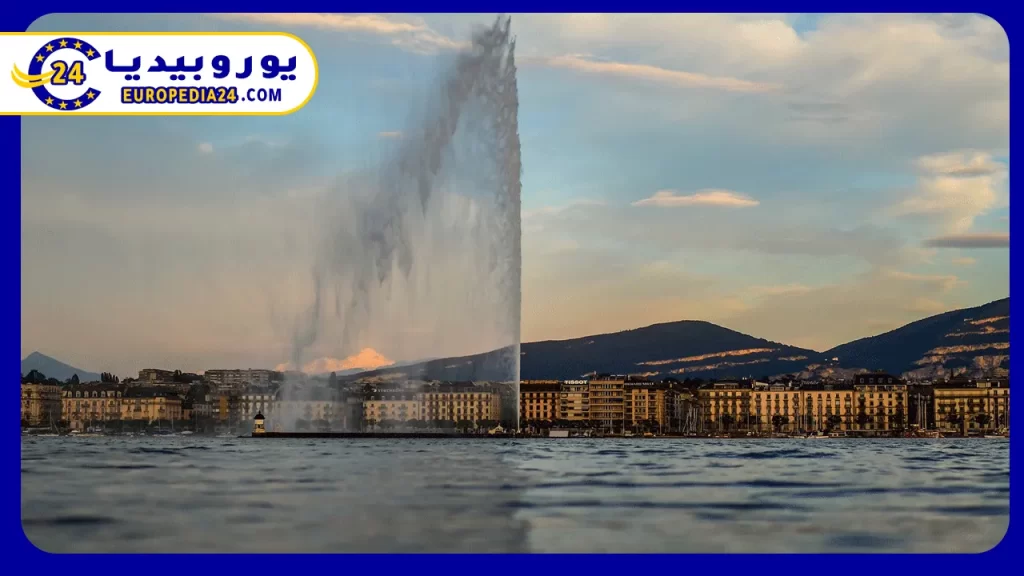
The fountain was initially designed to reduce water pressure from pumping for the city’s residents, but in 1891 it witnessed significant development until it became one of the most important attractive tourist attractions.
At that time, it operated with a capacity of only 90 metres, but in 1951 it witnessed significant development, by providing it with pumps and water sources, in addition to lighting, to become one of the main landmarks in Switzerland.
Read also – Get to know the top 10 Arab restaurants in Zurich
Reasons for building the Geneva Fountain in Switzerland
The primary goal of building the Geneva Fountain in Switzerland was not to make it one of the most important tourist attractions in the country, but it was built for technical reasons within the country.
In 1886, the city witnessed a significant growth in population by 36 thousand people, and thus the city became in dire need of energy in order to operate all its factories to increase production.
Switzerland has already sought to build a hydraulic factory based on the existing power distribution network in Rhône, and the hydraulic pump now uses water to operate machines in watchmaking workshops.
Hence the problem began to appear, which is that when workers stop working at night, excess pressure in the system begins to build up, and therefore engineers must stop the pumps one by one.
The engineers decided to install a safety valve to control the pressure, which was known as the famous water jet. The height of the fountain at that time was about 30 meters.
Accordingly, a solution to the problem was reached, and it became necessary to release this pool of water in order to avoid pressure accumulation, but on the other hand, the sight of water rushing from the fountain attracted the admiration of all passers-by.
Accordingly, the city moved to transform the fountain into a tourist attraction within Switzerland, so that citizens and tourists could visit the famous landmark with ease.
The Geneva Fountain was moved to a more visible spot on the quayside in Eaux-Vives, where it is today, and was inaugurated in 1891 at the Federal Gymnastics Festival.
Since then, the fountain has begun to witness many different developments, as it was lit for the first time during the celebration of the sixtieth anniversary of the Swiss Confederation.
Read also – Learn about Map of Switzerland and the most important tourist places
Features of the Geneva Fountain in Switzerland
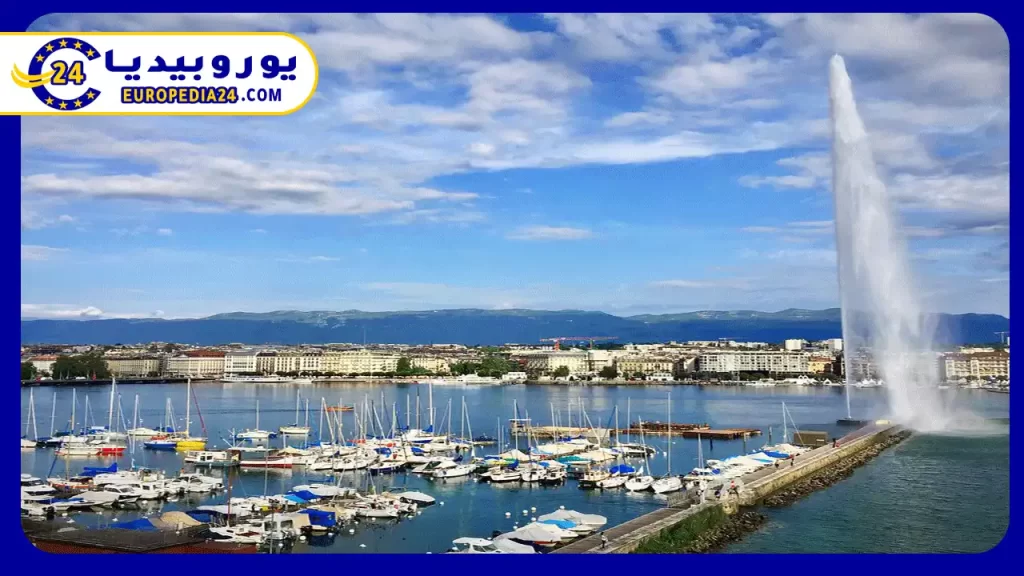
Geneva’s Jet d’Eau has many features that have made it one of the most important and best tourist attractions in the country. Its fame has also extended to all parts of the world.
The fountain witnesses a wide demand from tourists from all over the country to see the water rising with the wonderful lights, especially in the evening. You can also get on boats in the water and watch this wonderful sight up close.
The most important features of the fountain are as follows:
- There are many outdoor courtyards surrounding the fountain where you can sit and enjoy the wonderful view.
- A visit to the Fountain of Geneva is suitable for children.
- The Geneva Fountain is free to enter and you do not need to reserve tickets to visit it.
- It is considered one of the most important places suitable for family gatherings in order to spend a very special time.
- The Geneva Fountain is also one of the most important places suitable for people with special needs.
Read also – The best hotels in Zurich, Switzerland
Design of the Geneva Fountain in Switzerland
Geneva’s Jet d’Eau has witnessed many changes and developments, as the new pumping station has the capacity to push one cubic meter of water into the air every two seconds.
Accordingly, about 500 liters of water are expelled per second at a speed of 200 km/h, and the Jura and Salif pumps now pump about 7 tons of water, as they were manufactured by the Swiss company Sulzer.
The Geneva Fountain also includes a small nozzle that allows water to drop in medium-sized drops, filled with small bubbles, and thus the evaporation process contributes to giving the fountain a white color throughout.
The fountain also has a removable walkway to allow people with disabilities access to the sidewalk so they can view the fountain up close and participate in group tours.
Read also – The best tourist places in Zurich, Switzerland
Working hours of the most famous European landmarks, Geneva Fountain
Geneva’s Jet d’Eau initially operated only on Sundays and public holidays, in order to draw water from the drinking water system.
But the city noticed that the fountain was very popular with citizens and tourists, so it decided to operate it starting in 1906 from time to time during the week.
But after that time and until the present time, the fountain was operated seven days a week, in addition to changing its shape and relying on only one hole to extract water from 5 holes.
Read also – Best places for shopping in Zurich Switzerland
Cases when the Geneva Fountain in Switzerland stops working
It should be noted that the famous Geneva Fountain in Switzerland is not an automatic fountain, but there are some people responsible for turning it on every morning by pressing a dedicated button.
The people responsible for this are retired SIG employees who volunteer to operate the fountain and at the same time receive a salary for it.
But there are some cases that lead to the fountain closing completely and stopping it from working, which are as follows:
- When the wind rises, the fountain must stop working so that water does not fall on boats or the dock.
- When temperatures drop to the freezing point, the fountain must be stopped to prevent the passages from being covered with a sheet of ice due to falling water.
Read also – Learn about The best tourist places in Belgium that you can visit and enjoy
The most famous tourist attractions near the Fountain of Geneva in Switzerland
When you finish visiting the Geneva Fountain in Switzerland, you can go to many other distinctive tourist areas, in order to have a fun time, or to eat some of the delicious food that Switzerland is famous for.
The most important tourist places near the Geneva Fountain are as follows:
- Buckeyes pigeons.
- Mumbai Palace Restaurant.
- English Garden.
- Flower hour.
- Tosca Restaurant.
Read also – The best tourist places in France that you cannot miss visiting
The most popular hotels near the Swiss Fountain of Geneva
If you want to stay in a hotel after visiting the Geneva Fountain, you cannot look far from the area, as there are many distinctive hotels close to the fountain.
These hotels are distinguished by providing the best types of services to travelers and customers, and the most famous of these hotels are as follows:
- Metropole Hotel.
- Novotel Geneva Centre.
- Warwick Hotel Geneva.
- Intercontinental Geneva Hotel.
Read also – Learn about The best tourist places in Luxembourg
FAQ about the Geneva Fountain in Switzerland
Where is the Geneva Fountain located?
The Geneva Fountain is located on Lake Geneva in Switzerland, where you can easily go to it in order to enjoy seeing one of the most famous landmarks in the country.
What is the height of the Geneva Fountain?
The height of the water from the Geneva Fountain currently reaches about 140 metres, after it has witnessed many changes and developments since the moment of its construction, becoming one of the most famous tourist attractions in Switzerland.
A concise answer based on search intent
Geneva’s Jet d’Eau is widely known within the country and also internationally, as it is considered one of the most famous and important European landmarks. In short: This guide helps you understand the topic in Switzerland, explaining what to check before making a practical decision.
How to use this information with confidence
The value here is not only in displaying information, but in linking it to an actionable step: Do you need to make a reservation, submit an order, compare a cost, review a legal requirement, or confirm with an official body? So we added verification points and direct sources that reduce the possibility of error.
Checks to make before deciding
- Check the official website of the place or city for opening hours, prices and seasonal changes.
- Compare the location with transportation and nearby housing so that the cost of the visit is not higher than expected.
- Use guest reviews as a helpful signal, but check reservations and policies from official channels.
Official sources and trusted references
Frequently asked questions
Do the details differ within Switzerland from one city or destination to another?
Yes, many practical details may differ depending on the city, institution, or type of request, so you must refer to the source responsible for your specific case.
Can you rely on this article alone?
The article helps you understand the picture and take a more conscious step, but it does not replace the official source or specialized advice if the decision is legal, financial, or academic.
Editorial note: This content was editorially revised on July 11, 2026 to add a clearer answer to the researcher’s intent, authoritative sources, and practical checkpoints that enhance trust and expertise.
This post is also available in:
 العربية
